
Recent Work • Port Townsend, WA • Septic Installation
Septic System Installation in Port Townsend, WA
A 1960s tank and drainfield had finally given out, with effluent surfacing in the yard. We designed, permitted and installed a new 1,250-gallon tank and gravity drainfield — inspected and back in service in three working days.
Service
Septic System Installation
Location
Port Townsend, WA
Property
3-bedroom single-family home
New tank
1,250-gallon two-compartment
Time on site
3 working days
Job Report
| Service requested | Septic system replacement |
|---|---|
| Location | Port Townsend, Washington |
| Property type | 3-bedroom single-family residence |
| Homeowner's goal | Stop the surfacing effluent and pass county approval |
| Existing system | Original 1960s 750-gallon concrete tank, gravity drainfield |
| System age | Approximately 60 years |
| New tank installed | 1,250-gallon two-compartment concrete tank |
| Effluent filter | New outlet filter installed |
| Drainfield | New gravity drainfield, three trenches |
| Permitting | Jefferson County Public Health permit and design |
| Total time | 3 working days on site |
| Final status | Installed, backfilled, inspected and approved |
Conditions When We Arrived
The homeowner called about a soggy patch in the side yard that never dried out, along with an odor near the back of the house. Drains inside had started to run slow.
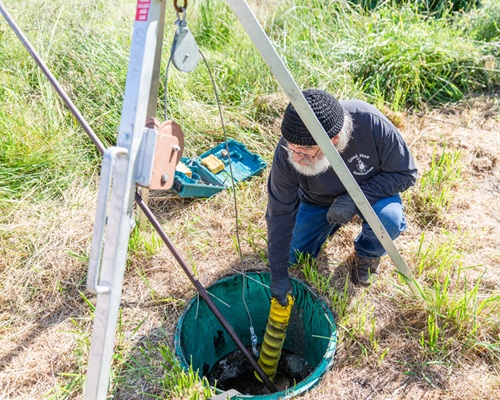
We pumped and opened the original tank to see what was actually happening before recommending anything — the goal is to confirm the condition, not to sell a new system.
- Reported symptom
- Standing water and odor over the drainfield
- Tank condition
- Cracked inlet baffle, no outlet filter
- Drainfield
- Saturated, no longer accepting effluent
- Last pumped
- Roughly 18 months prior
- Water use
- Household of four
- Reason for service
- System failure confirmed during inspection
What Our Technician Found
Four things determined that this system needed replacement rather than repair.
The tank had reached the end of its life
The original 750-gallon tank was undersized for a three-bedroom home by today's standards, and the inlet baffle had broken away, letting solids pass straight through toward the drainfield.
Solids had blinded the drainfield
Years of carryover had sealed the trench bottoms. Once a drainfield is blinded like this, pumping the tank only buys weeks — the soil can no longer absorb effluent.
The site had room for a new field
Soil logs and a test pit showed suitable soil in the side yard with the required setbacks from the well, property lines and the bluff, so a standard gravity system was possible.
No pump or mound was required
Because the new field sits below the tank and the soil percolated well, effluent flows by gravity. That kept the cost and long-term maintenance down for the homeowner.
Could This System Have Been Repaired Instead?
No.
A cracked baffle on its own is a repair. Once solids have blinded the drainfield trenches, the soil no longer accepts effluent and no repair brings that back. Before recommending replacement we check:
- Tank size versus bedroom count
- Inlet and outlet baffle condition
- Whether an effluent filter is present
- Liquid level and evidence of backup
- Whether effluent is surfacing
- Soil and setbacks for a replacement field
- Permit and as-built history
If your system is only showing early symptoms, start with a septic inspection instead.
How The Job Went
- Day 0
Site evaluation & design
Our team pumped and opened the existing tank, confirmed the failure, dug a test pit, logged the soil and laid out a gravity system that met the required setbacks.
- Day 0
County permit
The design was submitted to Jefferson County Public Health, and the installation was scheduled once the permit came back approved.
- Day 1 — 7:30 AM
Utility locates & staging
Underground utilities were located and marked, the work path was protected, and the new tank and gravel were staged on site.
- Day 1 — 9:00 AM
Old tank decommissioned
The failed tank was pumped dry, the lid broken out and the shell crushed and removed per state requirements so it could never become a void.
- Day 1 — 1:00 PM
New tank set
The new 1,250-gallon two-compartment tank was set on a level bedded base, plumbed to the house line, and fitted with risers to grade and a new outlet effluent filter.
- Day 2 — 8:00 AM
Drainfield trenches
Three gravity trenches were excavated to the designed depth, bedded with drain rock, and the perforated distribution pipe laid to grade and leveled.
- Day 2 — 2:00 PM
Distribution box & tie-in
A new distribution box was set and leveled so each trench receives an even share of effluent, then the tank outlet line was tied in.
- Day 3 — 9:00 AM
County inspection
The open system was inspected and approved by the county before anything was covered.
- Day 3 — 11:30 AM
Backfill & restoration
Trenches were covered with filter fabric and native soil, the yard was graded to shed surface water away from the field, and the site was raked and seeded.
- Day 3 — 3:00 PM
Homeowner walkthrough
We showed the homeowner the new riser locations, explained the effluent filter and the recommended pumping interval, and handed over the as-built drawing and permit paperwork.
The Completed Work
Every step below was completed and documented before we considered the job finished.
- Failed tank pumped, crushed and removed
- New 1,250-gallon two-compartment tank set and bedded
- Risers brought to grade with secure lids
- New outlet effluent filter installed
- Three gravity drainfield trenches installed
- Distribution box set and leveled
- County inspection passed before backfill
- Site backfilled, graded and seeded
- As-built drawing and permit provided
- Homeowner walkthrough completed
Final System Configuration
Tank
1,250-gallon, two-compartment concrete
Risers
To grade, both compartments
Effluent filter
Installed at the outlet
Drainfield
Gravity, three trenches
Pump required
No
Permit
Approved and closed
Install time
3 working days
Final status
In service
What Homeowners Can Take From This Job
A failing drainfield usually means the tank failed first.
A broken baffle or missing filter lets solids reach the field, and that damage is not reversible by pumping.
An effluent filter is cheap insurance.
It's the single best protection for a new drainfield, and it only needs rinsing at each pumping.
Soil decides the system.
Test pits and soil logs — not guesswork — determine whether you get a simple gravity field or a pump and mound system.
Permits protect the homeowner.
A county-approved design and a passed inspection are what make the system sellable when the home changes hands.
Pump on schedule after install.
Every three to five years for a household this size keeps the new field working for decades.
Questions About Septic Installation
How long does a septic system installation take?
On-site work is often two to four days for a standard gravity system. Site evaluation, design and county permitting happen before that and add a few weeks.
Do I need a permit to replace a septic system in Jefferson County?
Yes. A design must be submitted and approved, and the installed system is inspected before it can be covered.
Can my old tank stay in the ground?
No. A decommissioned tank must be pumped and either crushed and removed or filled so it can't collapse later.
Will I need a pump or a mound system?
Only if the site requires it. If the drainfield sits below the tank and the soil percolates well, a gravity system works and costs less to own.
How often should a new system be pumped?
Most households are on a three to five year interval. We'll set a schedule based on tank size and the number of people in the home.
Same-Week ServiceSeptic Pros Ready.
Serving the North Olympic Peninsula Since 1954 · Washington Certified · 4.8★ on Google
Call 971-328-7065Related Services
Septic Inspections
Find out whether a system is failing before it surfaces in the yard.
Septic Repairs
Baffles, filters, lids, lines and distribution boxes repaired.
Septic Pumping
Scheduled pumping that protects your new drainfield.
Membership Program
Set-and-forget maintenance on a schedule we track for you.